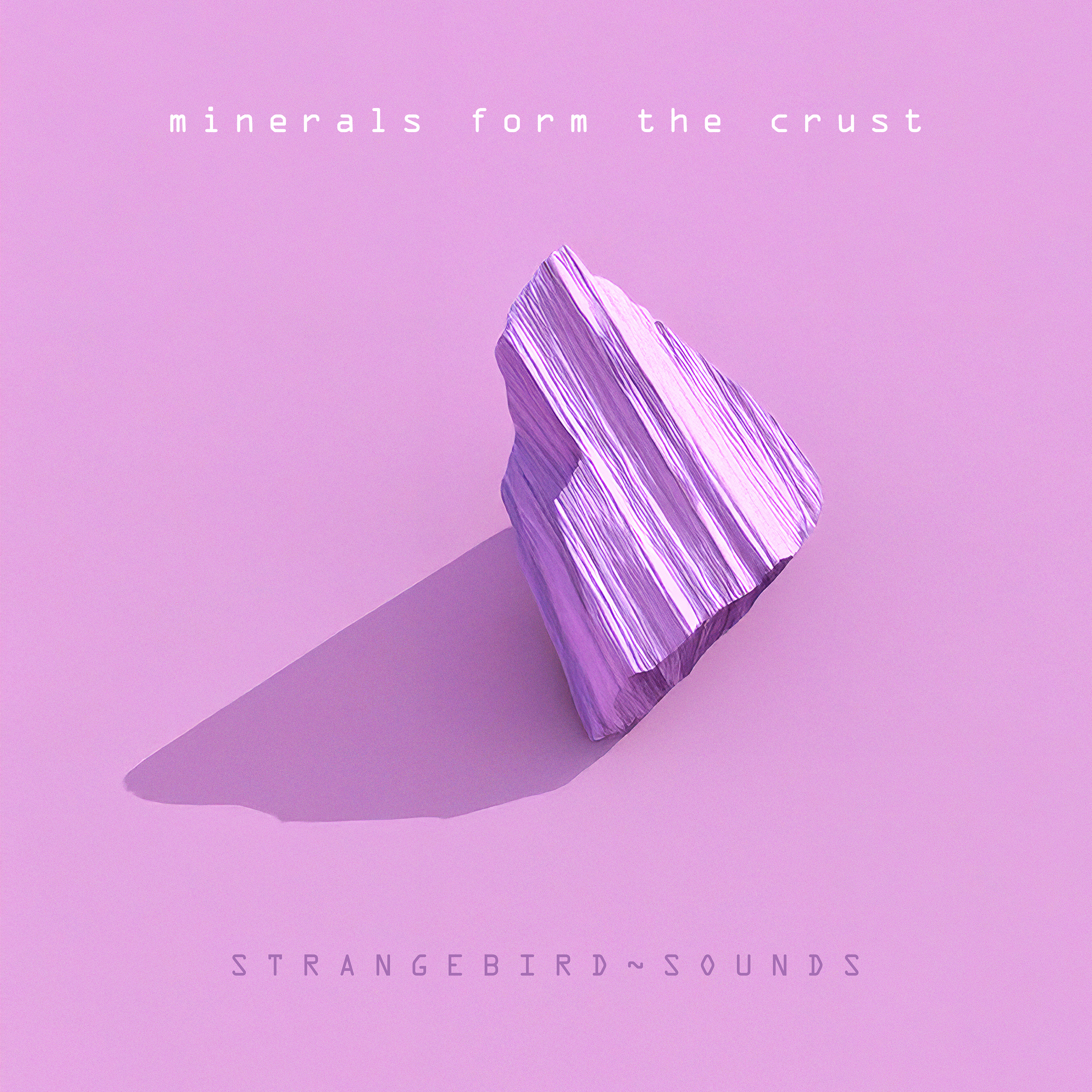
Minerals Form The Crust
Gregory Geerts creates evocative electronic music encompassing rich melodic content and ambient techno. “Minerals From the Crust” invites listeners on a sonic expedition inspired by the Earth’s layers, meticulously crafted using innovative Euro Rack modular synthesis techniques. The album uncovers deep textures and intricate patterns, hidden sonic jewels found beneath the earth’s surface, transforming geological marvels into a captivating auditory experience. Each track on the album acts as a sonic excavation, uncovering new timbres and rhythmic structures that reflect the complexity and beauty of the natural world.
“With ‘Minerals Form the Crust’, I wanted to capture the unpredictability and complexity of geological processes using the limitless possibilities of Euro Rack modular synthesis,” explains Strangebird~Sounds. “Every moment in the studio felt like uncovering a new element, a hidden frequency or a buried rhythm waiting to be revealed.”




Tracklisting:
- AMETRINE
- AZURITE
- BARYTE
- CALCITE
- CELESTINE
- FLUORITE
- MESOLITE
- NEPTUNITE
- ZEOLITE
Strangebird~Sounds
Renowned for his experimental approach to music production, Strangebird~Sounds takes his use of Euro Rack modular synthesis to new heights with this release. The artist’s custom-built modular system serves as the foundation for the album’s distinctive sound, allowing real-time manipulation of voltage, tone, and rhythm. Through creative patching and live performance techniques, he infuses each composition with organic unpredictability, ensuring a fresh experience with every listen.
Reviews
Monolith CocktailInspired by the natural jewels and gem-like minerals that lie beneath the Earth’s crust, the Belgium experimental composer Gregory Geerts, under the Strangebird–Sounds guise, transforms those crystallised forms into a most pleasant, subtle ambient-techno soundtrack and set of movements.
Materialising, metamorphosing and breathing each track is built around sonically capturing the abstract colourisation, the way the light plays, reflects or gleams on each chosen subject; add to that the soft use of environmental field recordings, the enervated veils of the surroundings and the just as subtle use of the everyday world in the form of various undulating captured voices, of play and people going about their business.
From the more commonly found Calcite to the rare quartz of Ametrine found almost exclusively centuries ago in just one mine in Bolivia, Geerts amplifies a sense of allure and mystery; but also feeds into the marvel of each element as it glistens and grows; pulses and vibrates. In doing so he opens up to the etymology and history, covering a millennia of usage: The atavistic Egyptians used to carve Calcite, relating it to their goddess Bast – hence part of the origins of the word alabaster -, and Ametrine, though long discovered by the native peoples of what would later become Bolivia, was, it’s been documented and said, to have made its way to Europe as part of the dowry between a local Ayoreo princess and Spanish conquistador in the 1600s. Sometimes these references are mythological: see the silicate mineral Neptunite, which is named after the Roman god of the sea of course, though because of its origins and locality of discovery is associated with the Scandinavian god of the sea, Ægir.
With the innovative use of a Eurorack modular apparatus our sound geologist presents an often lush, semi-tropical world of exotic birds, botanical foliage and replenishing life-giving waters. The underground is brought to the surface you could say, out into the open as it meets with the celestial and radiating. This is a subterranean world brough to life.
Both arpeggiator and freed-up notes bobble and bounce, or float like bulb-shaped and translucent particles and gentle specks against the biosphere; the synthesized; the occasional paddled tubular rhythms (on one occasion, almost like a Jeff Mills minimalist techno samba). The sounds of techno at its most sophisticated and ambient music, polygons and crystals, needles and sulphites all merge wonderfully to draw comparisons with the work of Xqui, Boards of Canada and Japanese environment music. Audiobulb continues to release some of the best work in this field, under the radar, out on the peripheral. Geerts Strangebird-Sounds vehicle is no exception; experimental without losing the listener; finding a most pleasant, inviting but also intriguing method, from the ground to the orbital, of giving sound to geological abstracts.
Original review > HERE